As you get older, your body gets softer. Unless you take control. Here is exactly what happens to muscle over the years, why it matters more than almost anything else for how you age, and the simple habit that changes the outcome.
By Matt McLaughlin, Founder, Capital Strength - Raleigh, NC
The Short Version:
|
The Uncomfortable Truth About Aging and Muscle
Here is something most people never get told plainly: after your 30s, the default setting of your body is to lose muscle and gain fat. Not because you did anything wrong. That is simply what happens when muscle is left unused.
The good news is that the default is not your destiny. The single biggest factor separating people who stay strong, capable, and independent from those who get soft, weak, and fragile is not luck or genetics. It is whether they train their muscles on purpose.
Let me show you what I mean, with three pictures that changed how a lot of my clients think about the next 30 years of their lives.
What Is Myosteatosis? Why Muscle Turns Into Marbled Steak
Take a look at these two cross-sections of muscle. Fair warning: it is graphic. That is the point.
On the left, you see dense, healthy muscle. On the right, you see muscle shot through with fat, marbled like a steak.
This has a name: myosteatosis. It is the medical term for fat building up inside and between your muscle fibers. Researchers now treat it as a distinct condition from ordinary muscle loss, and it is recognized as a common feature of aging.
Here is why it should get your attention. Myosteatosis increases with age, with excess body fat, and with inactivity, and it is closely linked to weaker muscles, poorer performance on movement tests, reduced insulin sensitivity, and a higher risk of losing your mobility. In older adults it even tracks with higher mortality.
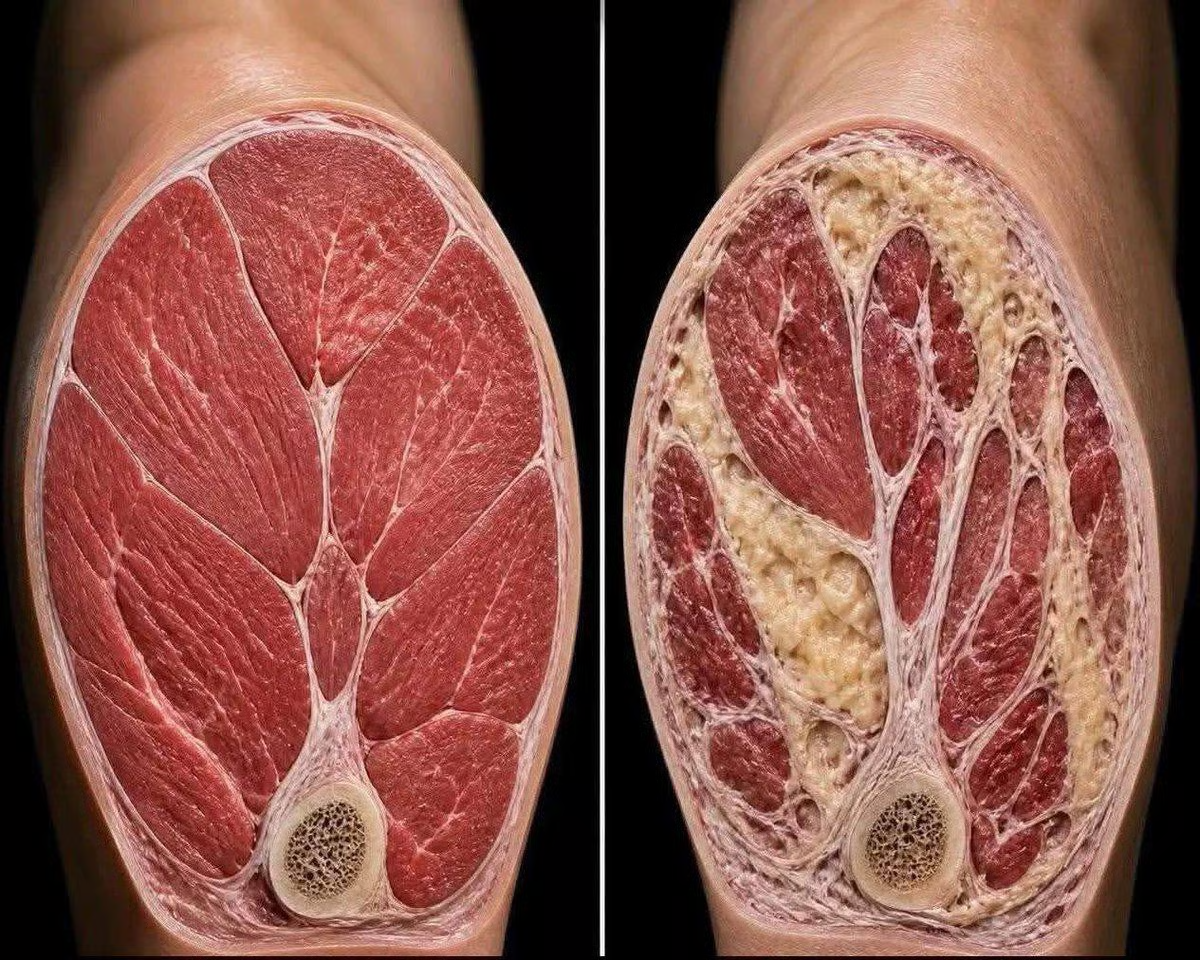
Left: dense, healthy lean muscle. Right: muscle infiltrated with fat, streaked through the tissue like the marbling in a ribeye. This fatty infiltration is called myosteatosis.
The hopeful part: this is not a one-way street. Resistance exercise has been shown to help prevent fat infiltration in muscle and improve strength at the same time. In other words, the same training that builds muscle also protects its quality from the inside out.
What Aging Muscle Actually Looks Like at 40, 70, and 74
If the last image felt abstract, this one makes it real. These are MRI cross-sections of the thigh from three different people, taken from a study of masters athletes by Wroblewski and colleagues.
Look at the top and bottom images first. One is a 40-year-old athlete. The other is a 70-year-old athlete. There is a 30-year gap between them, and their thighs are packed with dark, dense, lean muscle that looks almost identical.
Now look at the middle image: a sedentary 74-year-old man. The dark muscle has shrunk, and a thick pale layer of fat has moved in around it. Same species, same basic biology, wildly different outcome.
The takeaway is not "become a triathlete." It is that a huge share of what we casually call "aging" is actually disuse. The researchers behind these scans made exactly that point: much of the decline we blame on getting older is really the result of muscles that stopped being challenged. Keep loading your muscles, and they largely keep showing up for you.
A fair caveat, because I care about being straight with you: these athletes chose to train for decades, so this is a snapshot of what is possible, not a guarantee for everyone. But the underlying principle is one of the most consistent findings in all of exercise science. Use it, or lose it.
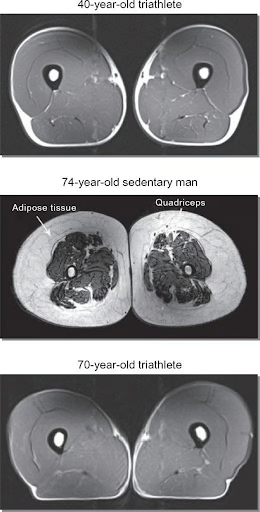
Thigh MRI cross-sections. Top: a 40-year-old triathlete. Middle: a 74-year-old sedentary man. Bottom: a 70-year-old triathlete. The dark tissue is lean muscle; the pale ring around the sedentary man's muscle is fat. Adapted from Wroblewski et al., 2011.
Strength Is About Healthspan, Not Just Lifespan
Most people think about aging in terms of how long they will live. The better question is how long you will live well, on your own terms, doing the things you love without needing help.
This curve tells the whole story. Everyone declines with age. But the trained line stays high above the threshold for independent living for decades longer than the sedentary line.
That gap is your healthspan. It is the difference between comfortably carrying your own groceries, playing with your grandkids, and traveling well into your 80s, versus needing help with stairs and daily tasks far earlier than you should. Strength training does not just add years to your life. It adds life to your years.
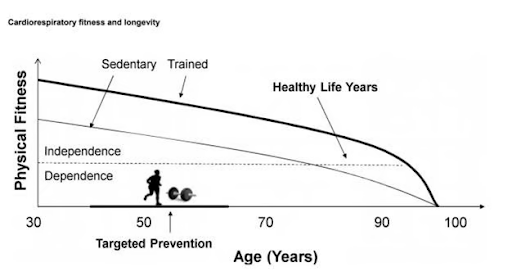
Physical fitness across the lifespan. Trained individuals stay above the threshold for independent living far longer than sedentary individuals, shrinking the years spent frail and dependent.
The Frailty Epidemic Is Real, But It Is Preventable
When muscle quietly disappears, the consequences are not just cosmetic. They are dangerous.
According to the CDC, about 1 in 4 adults age 65 and older fall every year, and falls are the leading cause of injury-related death in that age group. Nearly a million older adults are hospitalized from a fall each year.
Here is the part almost nobody hears: falls are not an inevitable part of aging. Two of the strongest protective factors are muscular strength and balance, and both are directly trainable. The CDC's own fall-prevention guidance points to improving strength and balance as a core strategy.
Being weak is being treated like a normal part of getting older. It should not be. Strength is a skill you can build at any age, and it is one of the most powerful forms of insurance you will ever invest in.
How Much Strength Training Do You Actually Need?
Less than you think. You do not need to live in a gym or train like an athlete. For most people, the trajectory changes with:
- 2 to 4 hours of strength training per week, spread across a few sessions.
- Progressive resistance so the challenge grows as you get stronger.
- Consistency over years, not intensity for a few weeks.
And here is the encouraging news: people of every age can make rapid strength gains. Beginners in their 50s, 60s, and 70s routinely surprise themselves in the first few months. The muscle is still listening. You just have to give it a reason to respond.
The one non-negotiable is consistency. You have to stick with it, ideally for life. The reassuring part is that it gets genuinely enjoyable once you start seeing progress and feeling the difference in how you move.
Why Training With a Coach Is the Smarter Path
If you are new to this, it can feel overwhelming. What to do, how much, how heavy, how to not get hurt. That overwhelm is exactly why most people either never start or quietly quit.
A good coach removes the guesswork. You get a plan built for your body, someone watching your form, and steady accountability that keeps you consistent long enough to see the payoff. It is the fastest, safest way to get real results, and it is the whole reason Capital Strength exists.
At Capital Strength in Raleigh, we do one thing and we do it well: private, coach-led strength training with a program built around you. Not a big-box gym. Not a bootcamp. Not a crowded class where you are on your own.
Training vs Exercise: The Difference That Decides Your Results
If you want real, lasting results, you have to understand a distinction most people miss. There is a difference between training and exercising.
Training is a systematic process aimed at a specific goal. You follow a plan, track your progress, and make adjustments over time.
Exercise is just movement. It might get you where you want to go, or it might not.
When you train properly, you stop leaving your results up to chance. You are not wandering the gym hoping something works. You are following a plan built for your body and your goal, which is what makes progress predictable instead of accidental.
Can you get some benefit from casual exercise? Sure. But it still takes consistency, doing the right things at the right time, and staying accountable. That is hard to pull off alone, without a plan, and without someone in your corner catching the mistakes before they become injuries or plateaus.
Two Versions of You
Strip all of this down and it comes to a simple choice. There are two versions of you waiting at the other end of the next decade:
- Sedentary, weak, tired, and fragile.
- Active, strong, energized, and robust.
You get to pick. Not in one grand decision, but in the small ones you make every day.
Every action you take is a vote toward who you'll be in the future. Which version of you are you voting for?
The difference-maker in that vote is strength training. It is the one habit that quietly shapes nearly every part of how you will feel, move, and live for the rest of your life.
A few things that tend to matter to people considering us.
If you want to build strength that lasts a lifetime and keeps you robust at any age, this is where you start. Come see for yourself what smart, professional-grade strength training feels like in a private gym built for it.
550+ five-star Google reviews
Real success stories from your Raleigh neighbors who built strength, recovered from injury, and reclaimed their health.
2,000+ clients coached
A proven track record of helping over 800 local busy professionals and seniors safely reach their physical peaks.
14+ years hands-on coaching
Decades of combined, hands-on professional expertise guiding clients through smart, injury-free movement.
Individualized programming, a private environment, and no long-term contracts.